Grey Sedgemoor Stitch Coaster Call: Free Crochet Pattern
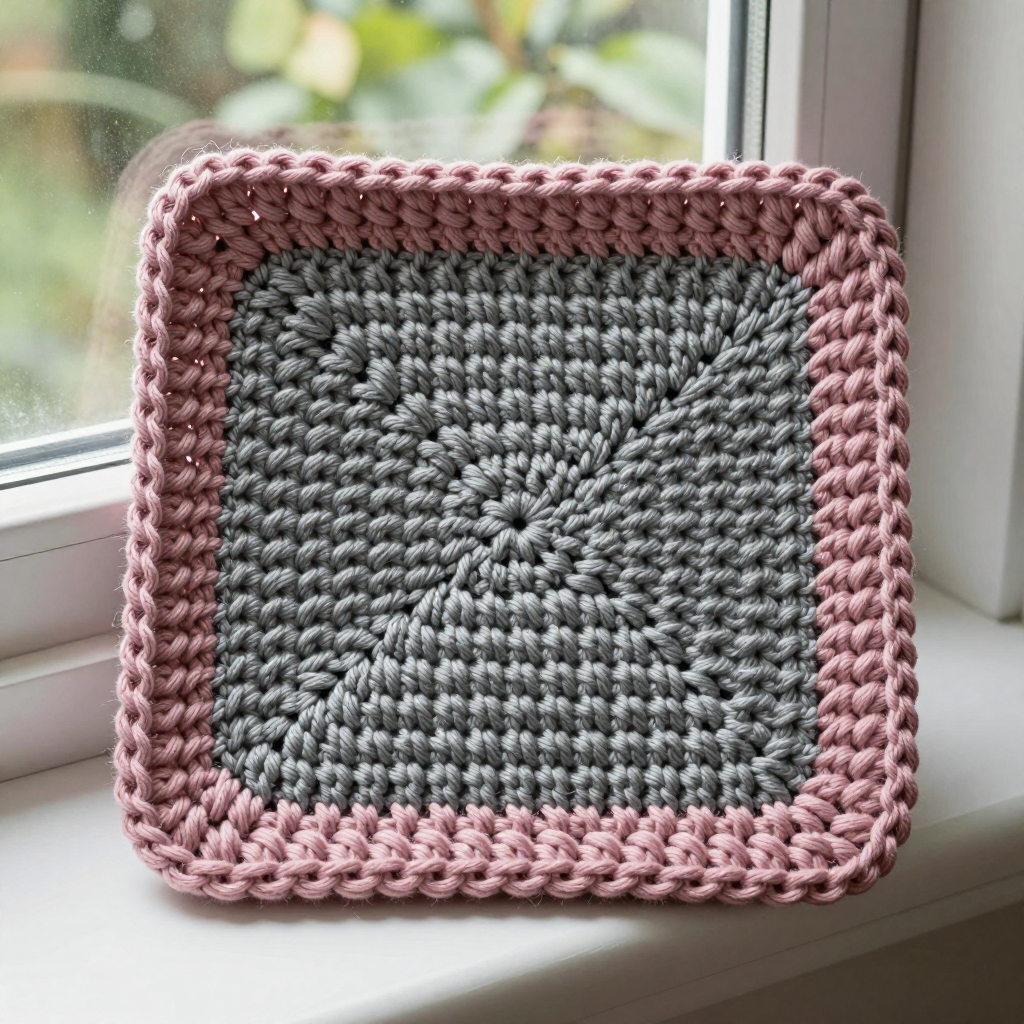
Grey Sedgemoor Stitch Coaster Call: Free Crochet Pattern
Introduction
Welcome to your very first crochet coaster! This little 4 x 4 inch square is the perfect project for someone who has just learned the basic stitches and wants to make something beautiful, useful, and finished in under an hour. The Grey Sedgemoor Stitch Coaster is worked in the lovely textured sedge stitch, which creates a dense, bumpy fabric made of tiny clustered groups that look far more complicated than they actually are. The center is a calm medium grey, framed by a warm dusty rose border that gives it a soft, western-inspired charm. When you finish, you will have a crisp, flat coaster with neat corners that feels sturdy and looks handmade in the best possible way. Grab your hook, pour a cup of tea, and let's make something lovely together.
Materials Needed
- Yarn: Worsted weight (category 4) cotton yarn — approximately 15 yards of medium grey and 5 yards of dusty rose. Cotton is recommended because it is absorbent, durable, and holds the stitch texture beautifully.
- Crochet hook: Size H/8 (5.0 mm). This is the hook that matches worsted weight yarn for a firm, dense fabric.
- Stitch marker (optional but helpful) — a small clip or safety pin used to mark a stitch so you don't lose your place.
- Tapestry needle — a large, blunt-tipped needle with a big eye, used for weaving in yarn ends.
- Scissors — for cutting yarn.
- Spray bottle of water and rust-proof pins — for blocking (shaping) the finished coaster.
- Finished size: Approximately 4 x 4 inches (10 x 10 cm).
Abbreviations and Beginner Glossary
Every abbreviation used in this pattern is listed below with a plain-English explanation. Read through this list once before you begin — it will make the instructions feel like a friendly conversation instead of a code.
- ch — chain. Make a loop of yarn on your hook, then pull the yarn through the loop. Each loop you pull through is one chain. Chains form the foundation of your work.
- sc — single crochet. Insert your hook into the stitch, pull up a loop (you now have 2 loops on your hook), then pull the yarn through both loops. That's one single crochet.
- dc — double crochet. Wrap the yarn over your hook once, insert the hook into the stitch, pull up a loop (3 loops on hook), pull through 2 loops, then pull through the last 2 loops. That's one double crochet.
- sl st — slip stitch. Insert your hook into the stitch, pull up a loop, and pull that loop straight through the loop already on your hook. It creates an almost invisible join.
- st / sts — stitch / stitches. One completed stitch, or several of them.
- turning ch — the chain (or chains) you make at the start of a row before you flip your work around. It lifts your yarn up to the right height for the next row.
- sedge stitch group — the special cluster used in this pattern: (sc, dc, sc) all worked into the same stitch or space. It creates a little textured bump.
- skip — do not work into that stitch. Simply pass over it and move to the next one.
- turn — flip your work over (like turning a page) so you can work back across the row you just made.
- fasten off — cut the yarn a few inches from your work, then pull the tail all the way through the last loop to lock it.
- weave in ends — thread a yarn tail onto a tapestry needle and sew it back and forth through the fabric so it disappears.
- join — connect the last stitch of a round to the first stitch with a slip stitch so the round closes into a circle.
Gauge
Gauge: 4 sedge stitch groups = 4 inches (10 cm); 8 rows = 4 inches (10 cm).
Why gauge matters: Gauge is simply how big your stitches come out. If your stitches are larger than the pattern expects, your coaster will be bigger than 4 inches; if they are smaller, it will shrink. Because this coaster is a fixed square, matching gauge keeps your finished piece the right size and keeps the border corners crisp.
How to make a gauge swatch: Using your grey yarn and H/8 hook, chain 16 and work Rows 1–2 of the pattern below. Measure the width of the sedge stitch section. If 4 groups measure about 4 inches, you are right on track. If your swatch is wider, try a smaller hook (such as G/6, 4.0 mm); if it is narrower, try a larger hook (such as I/9, 5.5 mm).
Beginner Tips Before You Start
- Count your stitches at the end of every row. Each row of this coaster should end with 6 sedge groups and 2 edge single crochets. Counting takes ten seconds and saves you from ripping out rows later.
- Use a stitch marker. Place a marker in the first stitch of each row so you always know exactly where the row begins and ends.
- Do not pull your yarn too tight. Tension should feel relaxed. If your stitches are so tight that the hook squeaks, loosen your grip — the sedge stitch needs a little room to show its texture.
- Remember the turning chains. A ch 1 at the start of a row does not count as a stitch. A ch 2 at the start of a row does count as the first double crochet. This is the single most common beginner mistake in this pattern.
- Work the sedge group into one stitch only. The (sc, dc, sc) cluster all goes into the same stitch or space. If you spread them across three stitches, the texture will disappear.
- Keep your work flat. Lay your coaster on the table after every few rows. If it starts to curl, your tension is too tight — relax and try again.
Step-by-Step Instructions
Base (Grey)
Row 1: With grey yarn, ch 16. Sc in the 2nd ch from hook and in each ch across. (15 sc)
Row 2: Ch 1, turn. Sc in the first sc. *Skip 1 sc, work (sc, dc, sc) in the next sc; repeat from * across until 2 sc remain. Skip 1 sc, sc in the last sc. (6 sedge groups, 2 edge sc)
Row 3: Ch 2, turn. Work (sc, dc, sc) in the first dc of the first sedge group. *Skip the next sc, work (sc, dc, sc) in the next dc; repeat from * across. Sc in the turning ch-1 space. (6 sedge groups, 2 edge sc)
Rows 4–9: Repeat Row 3 five more times. Do not fasten off. (6 sedge groups, 2 edge sc)
Total rows worked: 9. At 8 rows per 4 inches, 9 rows gives you a square of approximately 4 x 4 inches once the border is added.
Border (Dusty Rose)
Round 1: Change to dusty rose. Ch 1, do not turn. Work sc evenly around the entire perimeter of the square, placing 1 sc in each stitch along the sides and 3 sc in each corner to turn smoothly. Join with a sl st to the first sc. (Approximately 60 sc)
Round 2: Ch 1, sc in each sc around, working 3 sc in each corner. Join with a sl st to the first sc. Fasten off and weave in ends. (Approximately 68 sc)
Assembly and Finishing
Weaving in ends: Thread each yarn tail onto your tapestry needle. Turn the coaster to the wrong side (the back) and sew the tail back and forth through several stitches, changing direction once or twice so it cannot work loose. Trim the yarn close to the fabric. Do this for the grey starting tail and the dusty rose ending tail.
Blocking: Lightly mist the coaster with water until it is damp but not soaking. Pin it flat to a 4 x 4 inch square on a blocking mat or a towel, using rust-proof pins at each corner and along the edges. Make sure the corners are square and the sides are straight. Leave it to dry completely — usually a few hours or overnight. Blocking opens up the sedge stitch texture and gives you crisp, professional corners.
Pro Tips and Variations
- Change the colors: Try a cream center with a sage green border, or a charcoal center with a mustard border. Any two worsted weight cotton colors will work — just keep the same yardage.
- Make a set: This pattern uses very little yarn, so you can make a matching set of four or six coasters from one skein of each color. Work them assembly-line style, finishing all the centers first, then all the borders.
- Adjust the size: To make a larger coaster or a small mat, add 3 chains to your starting chain for every extra sedge group you want, and add 2 rows for every extra half inch of height. Keep the border instructions the same, working 3 sc in each corner.
- Substitute yarn: If you only have acrylic or a cotton-blend on hand, it will still work beautifully — just check your gauge, because acrylic can stretch slightly more than cotton. Avoid fuzzy or novelty yarns for your first coaster, as they make the sedge stitch hard to see.