Teal Horizon Entrelac Overcoat: Free Knit Pattern with Sunburst Chest Panel
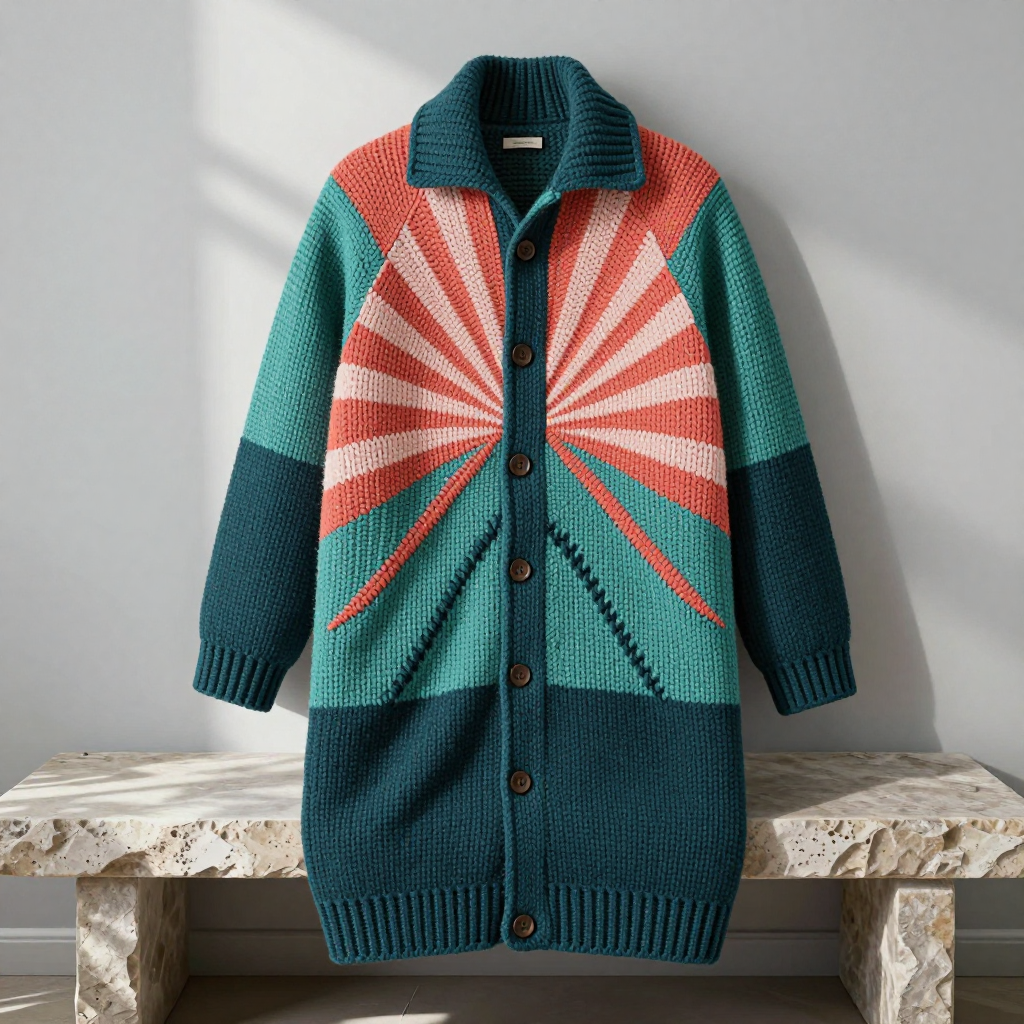
Teal Horizon Entrelac Overcoat: Free Knit Pattern with Sunburst Chest Panel
Introduction
Welcome to the Teal Horizon Entrelac Overcoat — a knee-length men's coat that looks far more complicated than it actually is. If you have never knitted before, this is a wonderful "big dream" project: every single block is just 7 stitches wide and 7 rows tall, so you only ever have to think about a tiny square at a time. The finished coat is a basketweave of 2-inch (5 cm) diagonal squares that grade from deep teal at the hem, through mid teal at the waist, into a glowing coral sunburst across the chest, and back to mid teal at the shoulders. In bulky wool it feels dense, warm, and slightly springy, with raised diagonal ridges you can trace with your fingertips. It is perfect for anyone who wants a statement coat and is ready to learn one beautiful technique, one small block at a time.
Materials Needed
- Yarn: Bulky weight (category 5) wool, approx. 100 g / 110 yd (100 m) per skein.
- Color A (deep teal): 9 skeins
- Color B (mid teal): 5 skeins
- Color C (coral): 4 skeins
- Color D (pale coral/peach): 2 skeins
- Total: approx. 20 skeins / 2000 g
- Main needles: US 10 (6.0 mm) straight or circular needles
- Spare needle: one extra US 10 (6.0 mm) needle for picking up stitches
- Ribbing needles: US 9 (5.5 mm) needles
- Stitch markers: at least 12 (to mark block edges and tiers)
- Tapestry needle: a large blunt needle for seaming and weaving in ends
- Scissors
- Buttons: 5 buttons, 1 in / 25 mm
- Stitch holders or scrap yarn for holding live stitches
Finished size: Men's S (M, L, XL, 2XL). Finished chest 42 (46, 50, 54, 58) in / 107 (117, 127, 137, 147) cm. Finished length 38 in / 96 cm (knee-length). Sample shown in size M.
Abbreviations and Beginner Glossary
- st / sts — stitch / stitches. One "stitch" is one loop on your needle.
- k — knit stitch (insert the right needle into the front of the stitch from left to right, wrap yarn around, pull the loop through, slide the old stitch off).
- p — purl stitch (insert the right needle into the front of the stitch from right to left, wrap yarn around, pull the loop through toward you, slide the old stitch off).
- RS — right side (the outside face of the fabric that people will see).
- WS — wrong side (the inside face of the fabric).
- sl1 — slip one stitch (move one stitch from the left needle to the right needle without knitting it).
- k2tog — knit two stitches together (insert the needle through two stitches at once and knit them as one; this decreases by one stitch).
- p2tog — purl two stitches together (purl two stitches as one; this decreases by one stitch).
- yo — yarn over (wrap the yarn once over the right needle to create a new stitch and a small hole; used for buttonholes).
- turn — flip your work around so the other side faces you, as if starting a new row.
- pick up and knit — insert your needle into the edge of the fabric, wrap yarn, and pull a loop through to create a new stitch on your needle.
- pick up and purl — the same motion, but you pull the loop through as if purling.
- selvedge — the finished side edge of a knitted piece.
- tier — one full diagonal row of entrelac blocks across the width of the piece.
- block — one small entrelac square (7 sts wide x 7 rows tall).
- foundation triangle — the starting triangle that creates the first slanted edge of entrelac.
- closing triangle — the ending triangle that makes a straight edge at the top of entrelac.
- mattress stitch — a seaming method that joins two edges invisibly, working under the horizontal bars between stitches.
- bind off — finishing an edge so stitches cannot unravel (knit two, lift the first over the second, repeat).
- rib (k1, p1) — alternating knit and purl stitches to make a stretchy, textured band.
- stockinette stitch — knit on RS rows, purl on WS rows; the smooth "V" fabric.
- blocking — dampening and pinning the finished pieces to shape and even out the stitches.
Gauge
14 sts and 20 rows = 4 in (10 cm) in stockinette stitch on US 10 (6.0 mm) needles. Each entrelac block = 7 sts wide x 7 rows tall = 2 in (5 cm) square.
Why gauge matters: Gauge is how big your stitches turn out. If your stitches are bigger than the pattern expects, your coat will be too large; if smaller, too tight. Because this coat is built from 2-inch squares, an off-gauge block throws off every measurement.
How to make a gauge swatch: Cast on 24 sts with US 10 needles. Work 24 rows in stockinette (knit one row, purl one row). Bind off. Lay it flat without stretching. Place a ruler across the middle and count how many stitches fit in 4 in (10 cm), then count rows in 4 in (10 cm). If you have more stitches than 14, go up a needle size; if fewer, go down. Also measure one entrelac block: it should be 2 in (5 cm) square.
Beginner Tips Before You Start
- Think in squares, not rows. You never knit a long row across the whole coat. You knit one 7-stitch block, turn, and knit back. If you can knit and purl, you can do this.
- Use stitch markers at every block edge. Place a marker each time you finish a block so you can count your blocks at a glance.
- Do not pull your yarn too tight when picking up stitches along a selvedge. Tight pick-ups make the blocks pucker and shrink below 2 in (5 cm).
- Always slip the first stitch of each block purlwise with yarn in front unless the pattern says otherwise. This creates the neat chain edge you will pick up from later.
- Keep a tally sheet. Write down each tier number and color as you finish it. Entrelac tiers all look similar, and a tally prevents color-plan mistakes.
- Weave in ends as you change colors. With 20 skeins and many color changes, leaving all ends to the end is overwhelming.
Step-by-Step Instructions
Entrelac Basics (read before starting)
Each block is 7 sts wide and 7 rows tall (2 in / 5 cm square). Blocks are worked diagonally in tiers. Right-side tiers are worked left to right; wrong-side tiers right to left. Always pick up 7 sts along the selvedge edge of the previous block. Slip the first st of every block purlwise with yarn in front unless told otherwise.
Color Plan (body): Tiers 1–6 Color A (deep teal). Tiers 7–9 Color B (mid teal). Tiers 10–12 Color C (coral) — this band carries the sunburst. Tiers 13–15 Color B, with Color D (pale coral) sunburst rays. Sleeves: Color A lower half, Color B upper half.
Back — Lower Body (entrelac panel)
With US 10 and Color A, cast on 49 (56, 63, 70, 77) sts. This is 7 (8, 9, 10, 11) blocks wide.
Foundation triangles (RS): *K1, turn; sl1, k1, turn; sl1, k2, turn; sl1, k2, k2tog, turn; continue in this manner, adding one st each RS row and working k2tog at the end of WS rows until 7 sts remain on the right needle. Do not turn.* Rep from * across to form 7 (8, 9, 10, 11) foundation triangles.
Tier 1 (WS, left-leaning blocks): Pick up and purl 7 sts along the left selvedge of the first triangle. Turn. (RS) K7, turn. (WS) P6, p2tog (last picked-up st with next foundation st). Rep these 2 rows until all sts of the adjacent triangle are consumed. Rep across the row to complete 6 (7, 8, 9, 10) blocks plus one final edge triangle.
Tier 2 (RS, right-leaning blocks): Pick up and knit 7 sts along the right selvedge of the first block. Turn. (WS) P7, turn. (RS) K6, k2tog (last st with next block st). Rep until the row is complete.
Tiers 3–12: Alternate Tier 1 and Tier 2, changing colors as listed in the Color Plan. Work 12 tiers total (approx. 24 in / 61 cm from cast-on). Place sts on holder.
Back — Sunburst Chest Panel (Tiers 10–15)
The coral band (Tiers 10–12) is worked in Color C. On Tier 11, center a sunburst motif across the middle 3 blocks: using Color D, work the center block in stockinette with a 7-st ray pattern (k1 D, k1 C, k1 D, k1 C, k1 D, k1 C, k1 D on RS; purl all sts on WS), and work the two flanking blocks with alternating D/C diagonal stripes (k3 C, k1 D, k3 C shifting one st each row). This creates a radiating sunburst across the chest. Continue the motif through Tier 13, then resume solid Color B.
Tiers 13–15: Work in Color B. On the final tier, work a closing row of triangles: *Pick up 7 sts, then (k1, k2tog) across until 1 st remains, k1; rep across.* Bind off all sts.
Front Panels (make 2, mirrored)
Cast on 28 (35, 35, 42, 49) sts = 4 (5, 5, 6, 7) blocks wide.
Foundation triangles: Work as for the back to form 4 (5, 5, 6, 7) triangles.
Tiers 1–15: Work entrelac tiers exactly as for the back, following the same Color Plan. Work 15 tiers to match back length. On the right front, work the sunburst motif on the block nearest the center front on Tiers 11–13 (mirror the ray placement). Bind off with closing triangles.
Sleeves (worked flat in entrelac, then seamed)
With Color A, cast on 28 (28, 35, 35, 42) sts = 4 (4, 5, 5, 6) blocks.
Foundation triangles: Work as for the back to form 4 (4, 5, 5, 6) triangles.
Tiers 1–3: Work entrelac tiers in Color A.
Tier 4 (increase tier): Work the tier as established, then add one foundation triangle at each edge (pick up 7 sts along the outer selvedge and work a new block). Sleeve is now 6 (6, 7, 7, 8) blocks wide = 42 (42, 49, 49, 56) sts.
Tiers 5–6: Work in Color A. Change to Color B after Tier 6.
Tier 8 (increase tier): Work the tier as established, adding one foundation triangle at each edge as on Tier 4. Sleeve is now 8 (8, 9, 9, 10) blocks wide = 56 (56, 63, 63, 70) sts.
Tiers 9–12: Work in Color B. Work 12 tiers total (approx. 24 in / 61 cm). Bind off with closing triangles. Make 2 sleeves.
Neckband and Front Edging
With US 9 needles and Color B, pick up 1 st per row along right front edge, 1 st per st around neck, and 1 st per row down left front edge. Work 6 rows in k1, p1 rib. On the right front band, work 5 buttonholes evenly spaced (yo, k2tog) on Row 3. Bind off in rib.
Hem
With US 9 and Color A, pick up 1 st per cast-on st along bottom edge. Work 8 rows k1, p1 rib. Bind off in rib.
Assembly and Finishing
Block the pieces first. Lightly dampen each piece with a spray bottle, lay it flat on a towel, and pin each entrelac block to exactly 2 in (5 cm) square. Let dry completely. This makes seaming far easier and evens out the blocks.
Seam the shoulders. With RS facing, use mattress stitch to join front and back shoulder edges, leaving a 9 (9.5, 10, 10.5, 11) in / 23 (24, 25, 27, 28) cm neck opening centered at back. To work mattress stitch: thread a tapestry needle, bring it up through the edge stitch on one piece and across to the matching edge stitch on the other, then pass under the horizontal bar between stitches on each side, pulling snug every few stitches.
Set in the sleeves. Pin the sleeve cap (the bound-off closing-triangle edge) to the armhole, matching the center of the sleeve to the shoulder seam. Sew with mattress stitch. Then seam the sleeve undersides and the side seams of the body in one continuous line from cuff to hem.
Weave in all ends. Thread each tail onto the tapestry needle and run it through the back of several stitches in one direction, then back through a few more in the opposite direction to lock it. Trim close.
Buttons. Sew 5 buttons opposite the buttonholes.
Final steam-block. Steam lightly, pressing the entrelac blocks flat without flattening the texture. Do not press hard with a hot iron directly on the fabric.
Pro Tips and Variations
- Change the color story. Swap the coral band for mustard and the pale coral rays for cream to make a golden-hour version, or use a single gradient yarn cake so the color shifts on its own.
- Adjust the size. Each block is 2 in (5 cm), so adding or removing one block across the width changes the chest by about 2 in (5 cm). Add one full tier to lengthen the coat by 2 in (5 cm).
- Substitute yarn. Any bulky (category 5) wool works; match the gauge swatch, not the label. A wool-alpaca blend gives more drape; a pure wool gives crisper blocks.
- Make it unisex. Shorten the body to hip length (work 10 tiers instead of 15) and omit the sunburst for a simpler, everyday jacket.