The Wildwood Fern Tunisian Scarf Free Pattern – A Crocheted Tapestry of Forest Textures and Mossy Hues
The Wildwood Fern Tunisian Scarf Free Pattern – A Crocheted Tapestry of Forest Textures and Mossy Hues
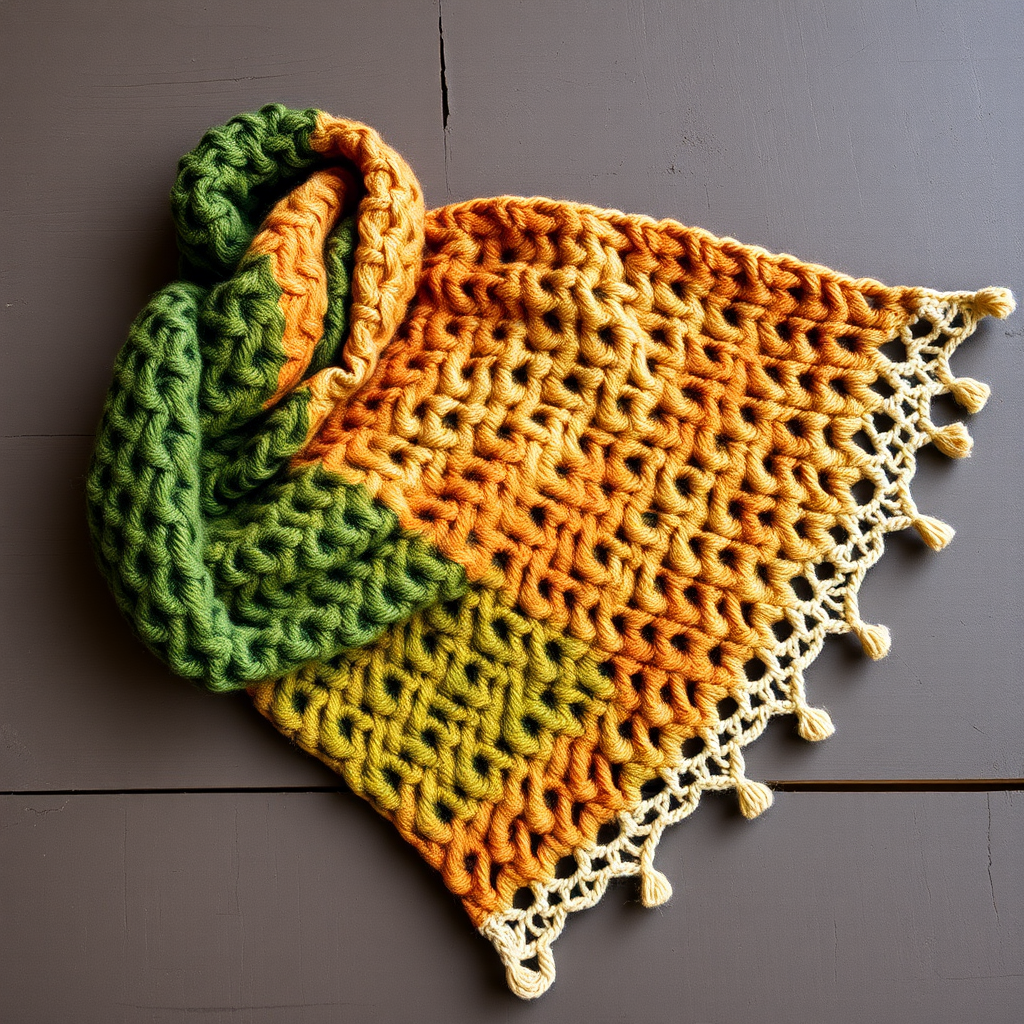
Wrap yourself in the untamed beauty of the forest with this Tunisian crochet scarf, featuring a lush interplay of fern-like stitches and earthy gradient tones. This pattern is a journey through texture, perfect for those who crave a modern, organic accessory. The long, rectangular silhouette drapes gracefully, and the ombre color flow—from deep forest green through mossy ochre to birch bark tan—evokes the dappled light of a woodland floor. Whether you're a seasoned Tunisian crocheter or a curious beginner, this project is a rewarding exploration of stitch patterns and color transitions.
Materials Needed
Before you begin, gather the following supplies. The quality of your materials will directly impact the drape and feel of your finished scarf, so choose a soft, plush worsted weight yarn for the best results.
- Yarn: Worsted weight yarn in 3 shades:
- Deep Forest Green (MC) – approximately 150g
- Mossy Ochre (CC1) – approximately 150g
- Birch Bark Tan (CC2) – approximately 150g
- Tunisian Crochet Hook: Size 6.5mm (US K-10.5) with a 12-inch cord. The cord is essential for holding the large number of stitches comfortably.
- Standard Crochet Hook: Size 5mm (US H-8) for the edging.
- Yarn Needle: For weaving in ends.
- Scissors: For cutting yarn.
Gauge
To ensure your scarf matches the intended dimensions, it's crucial to check your gauge. Using the 6.5mm Tunisian hook, work a swatch in Tunisian Simple Stitch (TSS).
Gauge: 14 stitches and 12 rows in Tunisian simple stitch over 4x4 inches (10x10 cm) with the 6.5mm hook.
If your gauge is off, adjust your hook size accordingly. A tighter gauge will result in a stiffer fabric, while a looser gauge will be drapier.
Step-by-Step Instructions
This scarf is worked lengthwise, which creates a beautiful, dramatic drape. The pattern combines Tunisian Simple Stitches (TSS) and Tunisian Knit Stitches (TKS) to create a woven, fern-like texture. Don't be intimidated by the Tunisian technique—once you master the forward and return passes, the rhythm becomes meditative.
Abbreviations & Key Terms
- FP: Forward Pass (the first half of a Tunisian row, where you pick up loops).
- RP: Return Pass (the second half of a Tunisian row, where you bind off the loops).
- TSS: Tunisian Simple Stitch – Insert hook under the next vertical bar, yarn over, pull up a loop.
- TKS: Tunisian Knit Stitch – Insert hook between the front and back vertical bars of the next stitch, yarn over, pull up a loop.
- MC: Main Color (Deep Forest Green)
- CC1: Contrast Color 1 (Mossy Ochre)
- CC2: Contrast Color 2 (Birch Bark Tan)
Foundation Row
With MC and your 6.5mm Tunisian hook, chain 36 loosely. It's important not to chain too tightly, as this will make the foundation row difficult to work into.
FP: Insert your hook into the back bump of the second chain from the hook, yarn over, and pull up a loop. Continue this across all 36 chains. You should now have 36 loops on your hook.
RP: Yarn over and pull through the first loop on your hook (this counts as your first stitch). *Yarn over, pull through two loops on your hook.* Repeat from * to * across until only one loop remains on your hook. This single loop is the start of your next row.
Rows 1-10: The Fern Texture (MC)
This section creates the primary fern-like texture using a combination of TSS and TKS.
Row 1 (FP): Skip the first vertical bar (this is the edge stitch). *Work TSS into the next 5 bars, then work TKS into the next 2 bars.* Repeat from * to * across, ending with TSS into the last bar. You should have 36 loops on your hook.
Row 1 (RP): Yarn over, pull through one loop. *Yarn over, pull through two loops.* Repeat from * to * across until one loop remains.
Row 2 (FP): Skip the first bar. *Work TKS into the next 2 bars, then TSS into the next 5 bars.* Repeat from * to * across, ending with TSS into the last bar.
Row 2 (RP): Same as Row 1 RP.
Rows 3-10: Repeat Rows 1 and 2 alternately. This creates a beautiful woven, textured fabric. At the end of Row 10, on the very last yarn over of the RP, change to CC1 by pulling the new color through the last two loops.
Rows 11-20: Diagonal Movement (CC1)
With CC1, we're going to shift the pattern to create a sense of diagonal movement, mimicking the way ferns unfurl.
Row 11 (FP): Skip the first bar. *Work TSS into the next 6 bars, then TKS into the next 2 bars.* Repeat from * to * across. You'll notice the pattern has shifted by one stitch, creating a diagonal line. End with TSS into the last bar.
Row 11 (RP): Standard return pass as before.
Row 12 (FP): Skip the first bar. *Work TKS into the next 2 bars, then TSS into the next 6 bars.* Repeat from * to * across, ending with TSS into the last bar.
Rows 13-20: Repeat Rows 11 and 12 alternately. At the end of Row 20, change to CC2 on the last yarn over of the RP.
Rows 21-30: A Smoother Band (CC2)
This section introduces a subtle variation, giving the eye a rest before the pattern repeats.
Rows 21-24: With CC2, work all stitches as TSS across the FP. This creates a smooth, solid band of color.
Rows 25-30: Return to the original fern pattern from Rows 1 and 2. Repeat Rows 1 and 2 three times. At the end of Row 30, change back to MC on the last yarn over of the RP.
Rows 31-60: The Grand Repeat
Now we'll repeat the entire sequence to create the full length of the scarf.
- Rows 31-40: With MC, repeat Rows 1-10 exactly.
- Rows 41-50: With CC1, repeat Rows 11-20 exactly.
- Rows 51-60: With CC2, repeat Rows 21-30 exactly.
At the end of Row 60, you'll have a beautifully striped, textured fabric with a gradual ombre effect.
Finishing Row: Tunisian Bind-Off
This bind-off creates a neat, elastic edge that mirrors the foundation.
FP: Insert your hook into the second vertical bar (skipping the first edge bar). Yarn over and pull through both loops on your hook. *Insert your hook into the next vertical bar, yarn over, and pull through both loops on your hook.* Repeat from * to * across until you have one loop left. Fasten off by pulling the yarn through the last loop.
Edging: A Delicate Finish
The edging adds structure and a touch of organic detail to the scarf.
With the 5mm standard crochet hook and MC, attach your yarn to any corner. Work a round of single crochet (sc) evenly around all edges of the scarf. At each corner, work 3 sc into the corner stitch to turn the corner smoothly.
To add the delicate picot detail, work the corners as follows: In the corner, work 1 sc, then chain 3, and slip stitch into the first chain (this forms a small picot loop), then work 1 more sc into the same corner stitch. Continue with sc around the rest of the edge.
Fasten off and weave in all ends with your yarn needle. Give your scarf a gentle block to even out the stitches and let the texture shine.
Your Wildwood Fern Tunisian Scarf is complete! The interplay of textures and the earthy gradient will make this a cherished accessory for years to come. Enjoy the cozy, handcrafted beauty you've created.


